An inverter that stops producing isn’t automatically a dead inverter. Some of the messages a solar inverter or its monitoring app shows point to something outside the inverter — the utility grid, a setting, a tripped breaker, or a lost internet connection — while others point to internal hardware that the manufacturer handles through its own return-and-replacement process. Which one you’re dealing with, what equipment you have, and whether it’s still under the manufacturer’s warranty decide whether the answer is a repair or a replacement. That’s why the first step is always a diagnosis, not a new inverter.
Step 1: Make sure the system has actually stopped producing
A blank app and a failed inverter are not the same thing. When monitoring goes quiet, the inverter may still be producing power and simply not reporting it. SolarEdge’s own troubleshooting note for its communication alerts starts with the home network — checking that the router is connected and has internet access, and, if the router was recently replaced, that its password or firewall settings weren’t changed — alongside simple checks of the inverter’s connectors and AC breaker.
If your app shows no data but nothing else has changed, read our guide to solar monitoring that’s offline or showing no data before assuming the worst.
Step 2: Read what the inverter is telling you
Most inverters show a code, a message or an LED color when something is wrong, and that message is one of the most useful things you can give a technician. Manufacturer documentation sorts these messages into very different groups:
- Grid-side messages. Some codes mean the inverter is reacting to the utility power, not failing. SolarEdge’s error-code guide, for example, says that when the grid is down, the inverter will restart after its reconnection time once AC voltage returns, and for grid voltage above the allowed limit it points to the inverter’s country setting and the grid operator.
- Safety faults in the wiring. SolarEdge’s documentation ties ground and isolation faults to insulation between the solar array and ground, and arc faults to connectors or cables that are damaged or improperly connected. SolarEdge says only a qualified technician should handle these, and after an arc fault the system has to stay shut down until the installation has been checked.
- Internal hardware faults. Other messages point to the inverter’s own electronics. SolarEdge’s guide marks several of these “Contact Support RMA” — the industry term for a manufacturer-authorized return of a faulty unit. These are the cases where replacing the inverter is the realistic outcome.
Look up what your exact message means in our solar error code library, which explains codes for SolarEdge, Enphase and SunPower equipment using the manufacturers’ own documentation.
When a repair may be enough
- The fault is outside the inverter. A damaged connector, a faulty string, a tripped breaker or a wrong setting can stop production without anything being wrong inside the inverter. In those cases the repair is aimed at the actual cause, not at the inverter.
- One unit has failed on a microinverter or optimizer system. On systems with a small electronic unit under each panel, a technician can check whether the problem is limited to one unit and whether that unit can be replaced on its own, using a compatible replacement where the original model is no longer made.
- The equipment is still supported. When the manufacturer still supports the product and parts or compatible replacement units exist, a targeted repair can be planned around those parts.
When replacement is the realistic path
- The manufacturer’s documentation points to the unit itself. When a fault is classed as internal hardware and the manufacturer directs it to its return process, the outcome is a return and replacement rather than a field repair.
- The model is older and replacements must be compatible. Older equipment can limit your options. Enphase, for example, says its IQ6 and IQ7 microinverters can’t be mixed with the older M-Series (M215 and M250) at the same site, and made IQ7-based replacement units specifically for M-Series systems. NYSERDA’s public project records list more than 1,200 Nassau and Suffolk projects with M215 microinverters, and a similar number with M250s, installed between 2011 and 2019. Our Enphase M215 and M250 guide covers it in detail.
- The equipment isn’t covered. On legacy SunPower systems, for example, Enphase states that SolarBridge inverters are not covered by the Enphase warranty, and points those owners to its upgrade programs.
- Failures keep repeating. When several units have failed, or you’re planning a battery, a broader upgrade may make more sense than replacing parts one at a time. A technician can compare the options for your roof and equipment.
Check the warranty before you decide
Inverter warranty terms differ by manufacturer, model and installation date — so the paperwork for your specific equipment is what counts. A few examples from manufacturer documents:
- Enphase says legacy SunPower systems “powered by Enphase” continue to be covered by its 25-year limited warranty.
- Enphase’s 2014 warranty for M215 and M250 systems covers a replacement unit but not the labor to remove the defective unit or install the new one.
- If you lease your SunPower system or have a power purchase agreement, Enphase directs you to the customer service number on your billing statement.
If the company that installed your system has closed, the manufacturer’s warranty may still apply. Our guides on getting access to manufacturer warranties and what to do if your solar installer is no longer in business walk through that situation.
What to have ready before a technician looks at it
- The exact message. Write down the code, message or LED color on the inverter display or in the app — or take a photo of it.
- When it started. Note the date production dropped in your monitoring and whether anything happened around then: a storm, roof work, a new router or an electrical change in the house.
- Your equipment details. The inverter brand and model from your installation paperwork, and the system’s installation date, help confirm warranty status and which replacements are compatible.
Don’t open the inverter, disconnects or junction boxes, and stay off the roof. Solar DC wiring can stay energized in daylight even when the system is switched off.
If you do replace it, look at the whole system
A replacement inverter has to work with the panels, optimizers or microinverters, and monitoring equipment you already have. It’s also the natural time to think about what you may want later, such as battery storage, because some combinations need specific equipment. Planning that once, at replacement time, can help avoid changing the same equipment twice. Our solar system upgrades page covers upgrading an older system.
How Renew Solar Services helps
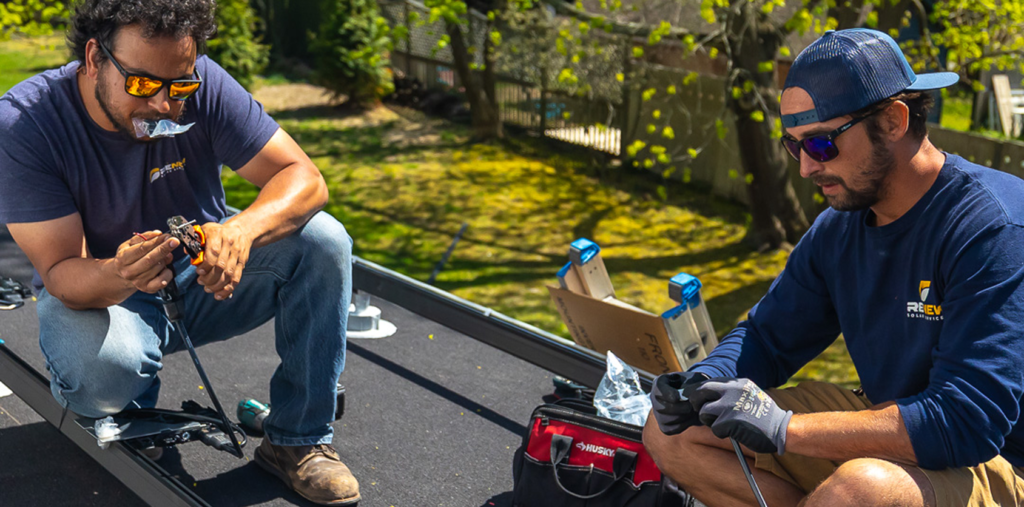
Renew Solar Services is led by a Licensed Master Electrician, and our licensed electricians diagnose inverter problems and explain whether a repair or a replacement fits your equipment. We are authorized to service and repair SolarEdge and Enphase systems, and we service SMA Sunny Boy, Power-One/Aurora, legacy SunPower and other older equipment across Nassau and Suffolk County.
If your inverter has stopped producing or is showing a fault, see our solar inverter replacement and repair service or call (631) 500-5115.